
Long-Term Mexican Car Insurance for Snowbirds 2026: Annual vs Monthly, and What to Check

By Scott Tobin · · 12 min read
Last updated:
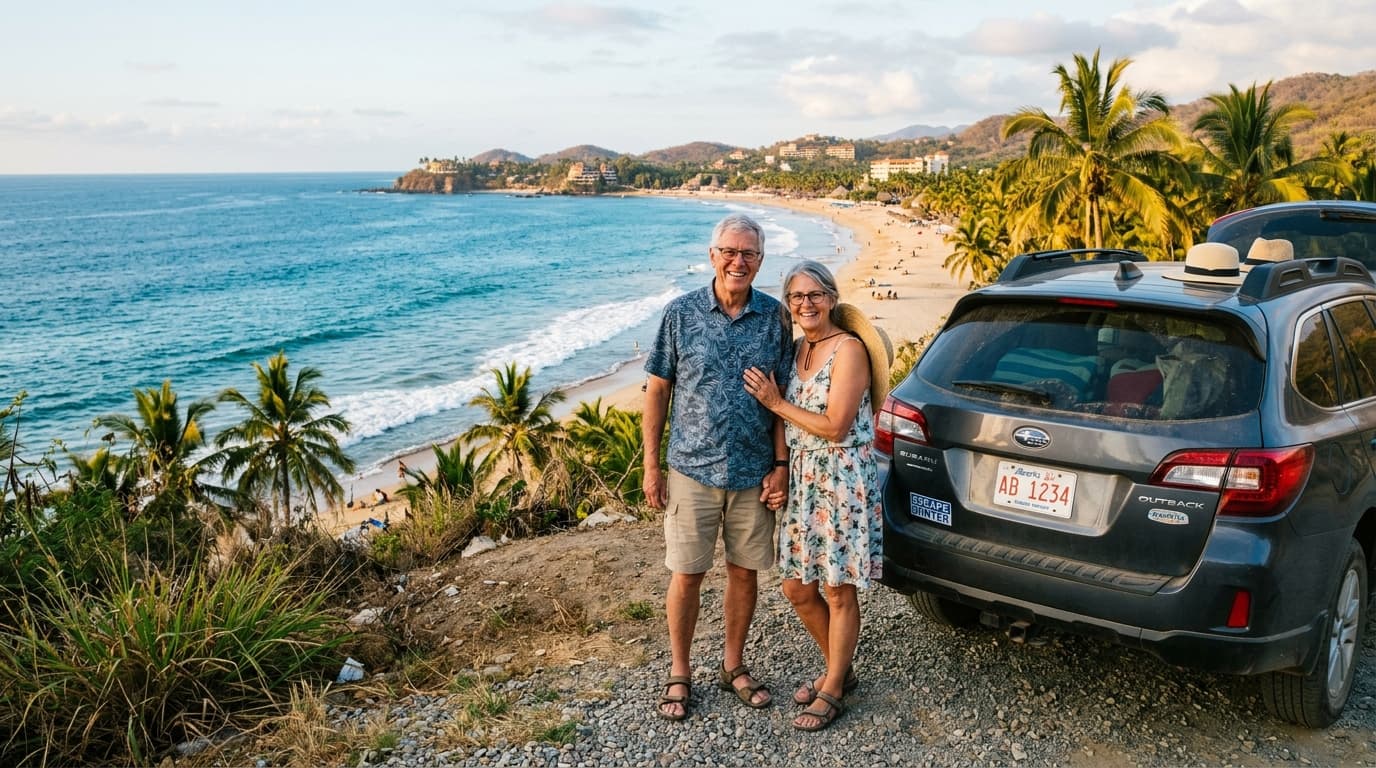
Most Mexican car insurance content is written for weekend trips. Snowbirds have a different problem: you're not buying three days of coverage, you're covering a four-to-six-month stay plus two long border runs, and the products that make sense are different.
The short version: if you're staying more than about six weeks, buy the annual. The details of which annual, and what to check before you sign, are where the money and the risk actually are.
First: which region do you actually need?
Before comparing durations, get the region right. Mexican policies are sold by geographic scope, and buying a cheaper regional policy for a destination it doesn't cover means you paid for nothing.
Baja Only — the Baja California peninsula, both states, Tijuana to Cabo San Lucas. The cheapest option. Correct for anyone wintering on the peninsula.
Sonora Only — the state of Sonora. Covers Puerto Peñasco (Rocky Point) and San Carlos. Slightly more than Baja Only, still well below Nationwide.
Nationwide — all of Mexico. Required for Mazatlán, Puerto Vallarta, San Miguel de Allende, Lake Chapala, and every other mainland destination.
The two errors that cost people real money:
Buying Baja Only for a Sonora destination. Rocky Point is not in Baja. It's in Sonora. A Baja Only policy there is worthless.
Buying a regional policy and then driving beyond it. The classic version is a Sonora Only holder who decides in January to continue down the coast to Mazatlán. Sinaloa is not Sonora. The moment they cross the state line they are uninsured, and they usually don't realise it.
If there's genuine uncertainty about where your season will take you, buy Nationwide. The premium difference is smaller than the exposure.
Our Sonora Only vs Baja Only guide covers the regional boundaries in detail.
The annual break-even
Here's the arithmetic that matters, for a mid-value vehicle ($20,000-$40,000) with full coverage.
Baja Only:
| Term | Typical cost | |---|---| | 1 week | $75-105 | | 2 weeks | $140-190 | | 1 month | $165-230 | | 3 months | $265-350 | | Annual | $300-350 |
Nationwide:
| Term | Typical cost | |---|---| | 1 week | $95-135 | | 2 weeks | $175-240 | | 1 month | $200-280 | | 3 months | $340-450 | | Annual | $400-500 |
Read those tables and the pattern is obvious: the three-month price is already at or above the annual price. By the time a snowbird is buying a season's worth of coverage, the annual is cheaper — and it keeps working for the other eight months.
Two ways to think about the break-even:
By trip count. Three or four short trips a year gets you to the annual price. If you cross for a long weekend four times, you've spent what an annual costs and you're uninsured the rest of the year.
By total days. Past roughly six weeks of cumulative coverage in a twelve-month period, the annual wins.
For anyone reading this as a snowbird, the answer is essentially always the annual. The interesting question isn't whether — it's which one and on what terms.
What the annual buys beyond price
Both border runs. People costing out a season sometimes price November through March and forget that the drive down in late October and the drive home in April are also driving. An annual covers the whole thing.
No lapse risk. The most dangerous thing about stacking short-term policies is the gap. Someone who bought three months in November and stays through March is uninsured for weeks without necessarily noticing. An annual removes that failure mode entirely.
Flexibility to extend. Plans change. Weather at home is bad, the family visit gets pushed, you just like it there. On an annual, staying an extra six weeks costs nothing.
Next season's first trip. A policy bought in October covers the following October's crossing too, if you renew on the same cycle.
What to actually check before you buy
This is the part most people skip, and it's where the differences between carriers live.
Renewal terms
- Does it auto-renew? Some policies do, some don't. If it doesn't and you assume it does, you'll be uninsured on next season's crossing.
- Is the renewal price guaranteed? Usually not. Ask what drives increases.
- Does the renewal require re-underwriting? If the vehicle ages out of a value bracket, the renewal quote can move.
Mid-policy cancellation and refunds
This is the single most important question for a snowbird, because plans change more than people expect.
- Is there a pro-rated refund? Some carriers refund the unused portion.
- Is it short-rated? Some apply a penalty scale, so cancelling at six months returns much less than half.
- Is there no refund at all? This exists. Know before, not after.
If there's a real chance you'll cut the season short — a health situation, a family obligation, a property sale — the cancellation terms may matter more than the headline premium.
Coverage limits and deductibles
- Liability limit. The legal minimum is not the same as adequate. Higher limits cost little more and matter enormously in a serious accident.
- Physical damage deductible. Often a percentage of vehicle value rather than a flat amount. On a $35,000 vehicle a 2% deductible is $700.
- Agreed value vs actual cash value. Agreed value pays a stated figure on a total loss. ACV pays depreciated market value. For an older vehicle this distinction is significant.
The extras that matter in Mexico
- Legal aid and bail bond. In Mexico an accident can be treated as a criminal matter until fault is established. Legal assistance coverage is not a luxury item here.
- Roadside assistance. Worth having on a peninsula or corridor drive with long service gaps.
- Medical payments. For you and passengers.
- Partial theft coverage. Ask specifically. Full theft and partial theft are sometimes handled differently.
Vehicle and driver details
- Named drivers. If your spouse will drive, they need to be on the policy. This is a common gap.
- Trailers. Frequently not covered automatically. If you're towing anything, get it named explicitly.
- Watercraft. Never covered by an auto policy. Separate product.
Seasonal use vs permanent use
This distinction catches people out and it's worth understanding before you buy an annual.
Seasonal use — the vehicle comes to Mexico with you and leaves with you. It spends part of the year in the US or Canada and part in Mexico. This is the standard snowbird pattern.
Permanent use — the vehicle stays in Mexico year-round, whether or not you do. Common among people who've been coming for years and eventually decided to leave a beater down there rather than drive it back and forth.
Why it matters:
- Some annual policies are written assuming one pattern or the other, and the assumption can affect the premium and, more importantly, how a claim is handled.
- A foreign-plated vehicle left in mainland Mexico raises TIP questions. The import permit is tied to your tourist status and has an expiry. A vehicle left behind after the permit lapses is a serious problem, and "I left it with a friend" is not a solution. (In Baja this doesn't arise, since the peninsula is a free zone and requires no TIP.)
- If you're moving toward Mexican residency, the vehicle's status has to change too. That's a conversation for a Mexican immigration specialist.
Tell your broker honestly which pattern applies. A policy written for the wrong one is the kind of problem that only surfaces at claim time.
Three worked examples
Abstract break-evens are less useful than actual situations. Here are three common ones.
The BC couple wintering in Rosarito, five months
November through March on the peninsula, one vehicle, occasional runs back to San Diego.
Region: Baja Only. They never leave the peninsula, and Nationwide would be roughly $100-150 of coverage they'd never use.
Term: Annual, not five months. Five months of short-term coverage exceeds the annual price, and the annual also covers the drives down and back, plus next October's crossing if they renew on cycle.
What to check: that both spouses are named drivers. This is the single most common gap in snowbird policies and it surfaces at exactly the wrong moment.
Roughly: $300-350 for the year.
The Arizona couple doing four Rocky Point long weekends
Four trips of three to four days each, spread across the winter, all in Sonora.
Region: Sonora Only. Baja Only would leave them uninsured — Rocky Point is in Sonora, and this is the most common regional error made by US drivers.
Term: This is the genuine break-even case. Four weekends at $42-75 each is roughly $170-300 of short-term coverage against a $320-380 annual. Short-term is marginally cheaper if they stick to four trips. A fifth trip, or one that extends, flips it — and the annual means never thinking about it again.
The tiebreaker: if there's any chance of a spontaneous fifth trip, buy the annual. If four is genuinely the plan, short-term is defensible.
The Minnesota couple wintering in Mazatlán, four months
December through March on the mainland, driving down through Nogales.
Region: Nationwide, without question. Mazatlán is in Sinaloa. Sonora Only would stop covering them hundreds of miles before they arrived, despite the whole first day being spent in Sonora.
Term: Annual. Four months of short-term Nationwide runs past the annual price, and they have roughly 1,800 miles of Mexican highway driving on top of the stay.
What to check: cancellation terms, because a four-month commitment from Minnesota is the kind of plan that changes. Also seasonal-use structure, since the vehicle comes home with them in spring.
Roughly: $400-500 for the year, plus the TIP deposit they must remember to reclaim on the way north.
Where short-term coverage still makes sense
The annual isn't always right. Buy short-term if:
- You're doing one trip and you know it. A two-week December visit doesn't justify an annual.
- You're testing a destination. First season, unsure whether you'll come back — buy the months you need and decide next year.
- You're flying down and renting. Rental coverage is handled differently; you're not insuring your own vehicle.
- Your total annual usage genuinely stays under about six weeks.
Our guide to temporary and short-term Mexican car insurance covers those cases, and the temporary auto money page has the product detail.
Practical management over a long stay
Set an expiry reminder for two weeks before. The single most useful thing on this page. A lapsed policy in month five is the most common way snowbirds end up illegally uninsured.
Keep a printed copy in the vehicle. Phone batteries die, rural cell coverage is inconsistent, and a policy you can't produce is a policy you don't have as far as a roadside conversation goes.
Keep the claims number somewhere other than your phone. Written down, in the glovebox, with the policy.
Know the claim procedure before you need it. Stay at the scene, call before moving the vehicle, don't admit fault, don't sign Spanish documents you can't read. Read your policy's specific instructions once, in October, when you're calm.
Re-check the region if your plans change. The February decision to drive somewhere new is exactly when regional policies bite.
Photograph the vehicle before crossing. Documents its pre-trip condition for any later dispute.
What snowbirds get wrong about long-term coverage
Buying month by month. Almost always more expensive, and it creates lapse risk.
Buying the cheapest regional policy without checking the destination. Baja Only doesn't cover Sonora. Sonora Only doesn't cover Sinaloa.
Not asking about cancellation terms. Then discovering there's no refund when plans change.
Assuming auto-renewal. Some policies renew, some don't.
Forgetting to add a spouse as a named driver. A common and entirely avoidable gap.
Assuming the trailer or boat is covered. Neither is automatic.
Buying liability-only for a season. It's legal and it leaves your vehicle uninsured for months of parking and thousands of miles of driving.
Letting it lapse in month five. Set the reminder.
Buying at the border. Booth vendors are legal but typically 2-3x online broker pricing with worse terms. Buy online before you leave home.
Frequently asked questions
When does an annual Mexican car insurance policy become worth it?
Generally once your total Mexico driving passes about six weeks a year, or after three to four short trips. For a snowbird staying a full season the annual is almost always cheaper.
How much does an annual Mexican car insurance policy cost?
Roughly $300-350 for Baja Only, $320-380 for Sonora Only, and $400-500 for Nationwide, for a mid-value vehicle with full coverage. Vehicle value, coverage limits, and deductible move these numbers.
What is the difference between Baja Only, Sonora Only, and Nationwide?
They are regional. Baja Only covers the Baja peninsula, Sonora Only covers the state of Sonora, and Nationwide covers all of Mexico. A regional policy leaves you uninsured outside its region.
Can I cancel a Mexican annual policy partway through?
Terms vary by carrier. Some allow cancellation with a pro-rated refund, others apply short-rate penalties or do not refund at all. Ask before you buy, not after your plans change.
Does an annual policy cover the drive down and the drive home?
Yes. That is one of its advantages over buying coverage for just the months you are parked in Mexico, since both border runs are covered by the same policy.
What is the difference between seasonal use and permanent use?
Seasonal use means the vehicle enters and leaves Mexico with you. Permanent use means it stays in Mexico year-round. Some annual policies are written with one assumption or the other, so match the policy to your actual pattern.
Do I need full coverage or is liability enough for a long stay?
Liability-only meets the legal requirement but leaves your own vehicle uninsured. For a season involving long highway drives and months of parking, most experienced snowbirds carry full coverage.
What happens if my policy expires while I am still in Mexico?
You are uninsured from that moment, and you are driving illegally. Set a calendar reminder two weeks before expiry and renew before the date, not after.
The other policy long-stay visitors need
Auto coverage is only half of it. A season-length stay also needs health cover, because provincial plans do not travel and Medicare provides essentially nothing outside the US. how expats get health insurance in Mexico with IMG Global walks through the temporary and long-term plan options and how to buy one from inside Mexico.
Going down more than once this year? Get covered before you go.
Related reading
- Mexican auto insurance — coverage, limits, and how it works
- Temporary Mexican auto insurance
- Temporary Mexican car insurance: 1-day, weekend, and trip coverage
- How much does Mexican car insurance cost in 2026?
- Sonora Only vs Baja Only — which policy covers what
- Driving to Mexico for the winter — what you need to know
Written from Rosarito, Baja California.
How to Choose Annual Mexican Car Insurance for Winter in Mexico
- 1Confirm which region you need — Baja Only, Sonora Only, or Nationwide — based on where you will actually drive, not where you cross the border.
- 2Estimate your total days in Mexico for the year, including the drive down and the drive home.
- 3Compare the annual premium against the short-term cost for that many days. Past roughly six weeks, the annual is usually cheaper.
- 4Check the renewal terms — whether the policy auto-renews, and whether the renewal price is guaranteed.
- 5Check the mid-policy cancellation and refund terms before you buy, not after your plans change.
- 6Confirm the coverage details: liability limit, physical damage deductible, agreed value versus actual cash value, and legal aid.
- 7Add every driver by name, and have any trailer named explicitly. Watercraft always needs a separate policy.
- 8Tell your broker whether the vehicle is seasonal use or stays in Mexico year-round, so the policy matches your actual pattern.