

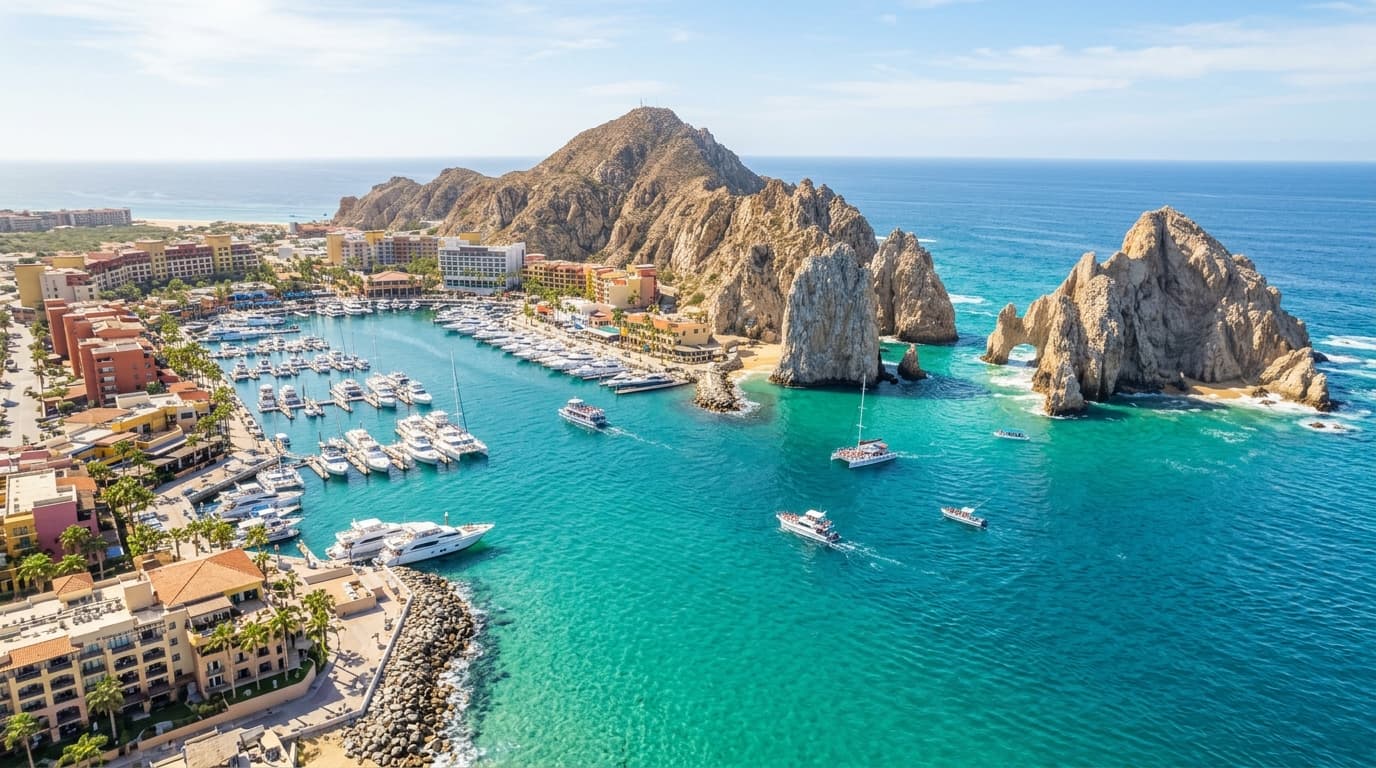
Cabo San Lucas is the southern tip of Baja California — about 1,000 miles from the US border, roughly two to three days of driving down Federal Highway 1. Most people fly to Cabo. The people who drive are usually going for one of three reasons: they're bringing a boat or trailer, they're moving to Baja, or they want to see the peninsula on the way.
If you're driving, this is one of the longest single-purpose drives in North America. Insurance planning matters more here than for any other Baja destination.
Why driving to Cabo is different
Cabo trips have three natural planning modes.
Fly in and rent: The default for most visitors. Baja Bound's FAQ says it cannot cover a vehicle rented in Mexico because it has Mexican plates, so ask the rental agency what Mexican liability coverage is included and what collision and theft cover costs, and check whether your own Mexican auto policy is written to cover rental cars.
Drive down for the drive itself: The classic Baja road trip. Usually 3-4 weeks including the drive, Cabo stay, and drive back. Full coverage on a Baja & Sonora policy (Baja Bound lists a Baja & Sonora Saver discount), with a term long enough for the drive, the stay, and the drive back.
Drive down to move or stay long-term: Snowbirds, expats, and property owners. Monthly or annual Baja & Sonora coverage.
For the two driving trips, federal law requires vehicles on federal roads and bridges to carry third-party liability insurance (Ley de Caminos, Puentes y Autotransporte Federal, art. 63 Bis).
Border crossing for Cabo
San Ysidro is standard. Same Highway 1 route as everything south of Ensenada.
Tecate works for LA-area drivers who want to skip San Diego traffic.
The drive from the border to Cabo
Roughly 1,000 miles total on Highway 1 (with Highway 19 as an option for the last stretch from La Paz).
Realistic trip length: 3 days if you push hard, 4-5 days if you enjoy the drive. Common overnight stops:
Day 1: Border to El Rosario or Guerrero Negro (400-450 miles). El Rosario is the traditional first-night stop; Guerrero Negro if you're pushing.
Day 2: To Loreto or Mulegé (400-500 miles from previous stop). These are natural overnight points.
Day 3: To La Paz or Todos Santos (300-450 miles).
Day 4 (if needed): Down to Cabo San Lucas (100-150 miles).
Or a 3-day version: Guerrero Negro, then Loreto, then Cabo. Doable but tiring.
From La Paz to Cabo, you have two route options: Highway 1 (via Los Barriles and San José del Cabo) is the standard route. Highway 19 (via Todos Santos) is slightly shorter and passes through the Pacific side. Both are paved and well-maintained.
Real prices for Cabo trips
Baja Bound quotes from 4 October 2026 for a $30,000 vehicle with full coverage in Baja and Sonora (2022 Toyota RAV4, policy starting that day), each range running from the cheapest to the dearest of three policies:
- 2 weeks (14 days): $274.14–$371.84
- 30 days: $514.77–$703.18
- 3 months (Baja Saver): $337.57–$468.67
- 6 months (Baja Saver): $385.32–$509.89
- Annual (Baja Saver): $424.31–$530.70
Most drive-down Cabo trips are 21+ days because of the drive time investment on both ends. Weekend trips to Cabo are for people who fly. For the drive down and the coverage that fits a Cabo trip, see our Cabo San Lucas page.
An annual policy may suit anyone making multiple Baja Sur trips per year or spending significant time in Cabo.
Common Cabo drive scenarios
Sport fishing trip with boat trailer: Boat insurance is separate. Baja Bound's FAQ says a towed boat and its trailer must be listed on the primary vehicle's policy, and that a separate watercraft liability policy covers the boat only while it is on the water. Verify both before you leave.
Snowbird winter stay: 1-4 months, November through April. A longer-term Baja & Sonora policy.
RV or camper trip: Baja Bound's FAQ says full coverage on vehicles over 25 years old is not available online (call), and that converted camper vans can generally be insured with documentation. Verify with Baja Bound before you leave.
Moving to Baja: If you're relocating, the drive is one-time but you'll need Mexican auto coverage ongoing after arrival. Annual coverage is the right choice.
Full peninsula loop: Some Baja regulars drive the full peninsula (border to Cabo and back) as an annual road trip. 3-4 weeks, monthly coverage.
Cabo + mainland via ferry: If you're taking the ferry from La Paz to Mazatlán, you need all-of-Mexico coverage. Mazatlán is in Sinaloa, which the US State Department's Mexico travel advisory lists as Level 4: Do Not Travel.
What Cabo drivers get wrong
Underestimating the drive: 1,000 miles on Highway 1 is not a casual drive. Three days minimum, ideally four.
Assuming the ferry means all-of-Mexico coverage is automatic: You need to choose all-of-Mexico coverage when buying your policy. A Baja & Sonora policy doesn't cover Mazatlán (in Sinaloa, a Level 4: Do Not Travel state) even if you drove your car onto the ferry.
Skipping full coverage: A 1,000-mile drive on a two-lane highway is where full coverage earns its price.
Trying to drive at night: plan overnight stops before sunset.
Assuming rental car agencies will accept my Mexican policy: Some do, some don't. Verify with your rental company before buying supplemental coverage.
Not planning fuel stops: fill up whenever you can and never let your tank get below half.
What to do if there's a problem on the road to Cabo
Standard fundamentals: stay at the scene, call the Baja Bound claim number, don't admit fault, don't sign anything you can't read. Baja Bound's FAQ says claims must be filed in Mexico before returning to the US, by calling the number on the face of the policy. Ángeles Verdes provide roadside help on 078; 911 is Mexico's emergency number.
Driving down for the whole winter?
A large share of the people who spend a season in Cabo drive here rather than fly, and most of them come from the Pacific Northwest or the Canadian Prairies. If that's your trip, the route matters as much as the destination — our origin guides cover departure timing, mountain-pass weather, where to break the drive, and why a Baja & Sonora annual policy is usually the cheapest coverage that actually works: Alberta to Baja, British Columbia to Baja, and Washington State to Baja.
For the wider planning picture — documents, permits, border waits, and money for a multi-month stay — start with our guide to driving to Mexico for the winter.
Got the route planned? Start a Mexican insurance quote.
Related reading
- Mexican car insurance for driving to La Paz
- Mexican car insurance for driving to Todos Santos
- How much does Mexican car insurance cost in 2026?
Written from Rosarito, Baja California.