

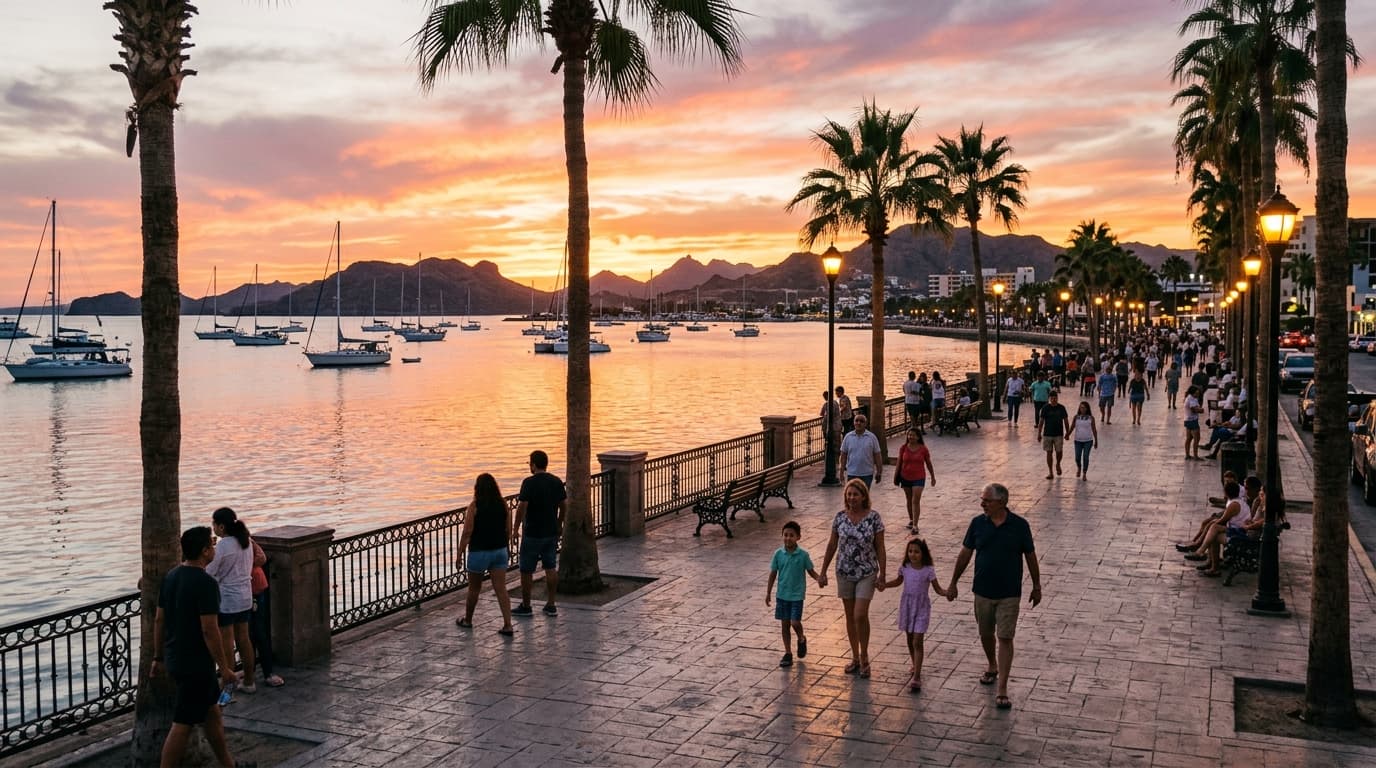
La Paz is the capital of Baja California Sur, about 900 miles south of the US border, and a solid two-day drive down Federal Highway 1. It's also one of the best small cities in Mexico for expats, snowbirds, and long-stay travelers — a real working city with beach access, better healthcare than most Baja destinations, and prices well below what you'd pay in Los Cabos or mainland Mexican beach resorts.
If you're driving to La Paz, the insurance planning is similar to Loreto but even more important. Here's what you need to know.
Why La Paz needs the maximum coverage
Everything I say about Loreto applies more strongly to La Paz. You're another 220 miles south. More time on the road. More distance from response infrastructure on any given stretch.
For a La Paz trip: full coverage minimum (liability + collision + theft + roadside + medical), verify legal aid coverage is included, verify medical evacuation coverage is included or add it separately, consider a higher liability limit (Baja Bound's quote offered $500,000 and $1,000,000) if you have significant personal assets to protect.
Full coverage costs more than basic liability, but it is the right call for a drive of this length.
Every vehicle on a Mexican federal road, route or bridge must carry insurance covering damage to third parties' property and people, and the owner is responsible for buying it (Ley de Caminos, Puentes y Autotransporte Federal, art. 63 Bis); art. 74 Bis II of the same law sets a fine for driving on federal roads and bridges without it. Baja Bound's FAQ says US and Canadian insurance is not proof of financial responsibility under Mexican law.
Baja Bound's auto page lists liability, physical damage, medical payments for the driver and passengers, legal assistance and bail bond with a limit matching the liability limit (available 24/7), and roadside assistance and towing.
Border crossing for La Paz
San Ysidro is the standard start. Same route as Loreto — you just keep going for an additional 220 miles.
Tecate works for LA-area drivers wanting to skip San Diego traffic.
Total drive from the border to La Paz is roughly 900 miles, 15-17 hours of driving, over two days minimum.
The drive from the border to La Paz
Same Federal Highway 1 as Loreto, extended.
Common two-day trip pattern: Day 1 goes from the border to Guerrero Negro (roughly 450 miles) with an overnight in Guerrero Negro. Day 2 continues from Guerrero Negro to La Paz (roughly 450 miles), arriving in La Paz in the evening.
Three-day pattern for a more relaxed trip: Day 1 border to Ensenada or El Rosario, overnight. Day 2 to Loreto or Mulegé, overnight. Day 3 to La Paz.
Between Ciudad Constitución and La Paz, the road briefly gets into more open, agricultural country. This is generally the smoothest stretch of the drive.
Download offline maps before you leave, and don't count on cell service until you're within 30 miles of the city.
Real prices for La Paz trips
Baja Bound quoted $144.57–$193.42 for 7 days, $274.14–$371.84 for 14 days and $514.77–$703.18 for 30 days (full coverage, $30,000 vehicle, Baja and Sonora, 4 October 2026). See the full price table.
Most La Paz trips are 10+ days because of the drive time. A one-week trip means 3-4 days in La Paz after the drive; not much time.
For snowbird trips of 1-3 months, monthly and multi-month policies are meaningfully cheaper per day than accumulated shorter policies. Baja Bound quoted 3-month terms at $337.57–$468.67 (Baja Saver policy).
An annual policy is worth pricing if you make multiple Baja Sur trips per year (Baja Bound quoted $424.31–$530.70 for annual on the Baja Saver policy).
Common La Paz trip scenarios
Snowbird winter stay: 1-3 months, October through April. Monthly Baja & Sonora policies from Baja Bound. La Paz is one of the most popular Baja Sur snowbird destinations for exactly this reason — mild winter, good infrastructure, real city amenities.
Whale shark season (October-March): La Paz's biggest annual attraction is snorkeling with whale sharks in the Sea of Cortez. 10-14 day trip typical.
Ferry gateway to mainland Mexico: La Paz is where you catch the ferry to Mazatlán or Topolobampo if you're driving across to mainland Mexico, and both of those ports are in Sinaloa, which the US State Department's Mexico travel advisory lists as Level 4: Do Not Travel. If you're taking the ferry, you'll need a policy for all of Mexico or a separate mainland policy.
Property owner trips: If you own in La Paz or the East Cape, annual Baja & Sonora coverage is the clear choice.
Sailing or boating trip: La Paz is a major Mexican sailing hub. Boat insurance is a separate Baja Bound product from auto (watercraft) — verify both if you're bringing a trailer boat or renting a sailboat.
Extended sabbatical stay: More Americans and Canadians are doing 2-6 month La Paz stays as remote work has normalized. Multi-month policies are the right approach.
What La Paz travelers get wrong
Trying to drive it in a day: No. 900 miles on Highway 1 is not a one-day drive. Two days minimum.
Assuming the Baja & Sonora policy doesn't cover this far south: Baja Bound's quote form asks whether you are only traveling to Baja or Sonora and quotes either a Baja & Sonora policy or one covering all of Mexico (our record of the quote run); if the trip stays on the peninsula, that is the Baja & Sonora quote.
Buying the all-of-Mexico policy for La Paz: Only necessary if you're taking the ferry to the mainland. A trip that stays on the peninsula is quoted as Baja & Sonora.
Skipping medical evacuation coverage: Serious medical situations in La Paz often mean transport to the US or major Mexican cities. Medical evacuation is the coverage you don't need until you desperately do. See our medical evacuation page for how it works.
Relying on Uber and taxis in La Paz: La Paz has decent taxi service and some ride-share. But if you drove down, you drove down. Your vehicle will be there for the trip; make sure it's insured.
Saving on insurance because fuel and food are cheap: The insurance is for the drive, not the destination.
What to do if there's a problem on the road to La Paz
Same fundamentals as any Mexico trip.
La Paz-specific considerations: Between Guerrero Negro and Ciudad Constitución is the longest sparse stretch — this is the section where full coverage and roadside assistance matter most. Download offline maps. Ángeles Verdes is Mexico's roadside-help service, reached by dialing 078; 911 is Mexico's emergency number (Sectur).
Driving down for the whole winter?
A large share of the people who spend a season in La Paz drive here rather than fly, and most of them come from the Pacific Northwest or the Canadian Prairies. If you are driving down for a season rather than flying, the route matters as much as the destination — our origin guides cover departure timing, mountain-pass weather, and where to break the drive: Alberta to Baja, British Columbia to Baja, and Washington State to Baja.
For the wider planning picture — documents, permits, border waits, and money for a multi-month stay — start with our guide to driving to Mexico for the winter.
Sorted everything but the cover? Quote your vehicle and dates.
Related reading
- Mexican car insurance for driving to Loreto
- How much does Mexican car insurance cost in 2026?
- Mexican car insurance for tourists — what you need to know
Written from Rosarito, Baja California.