

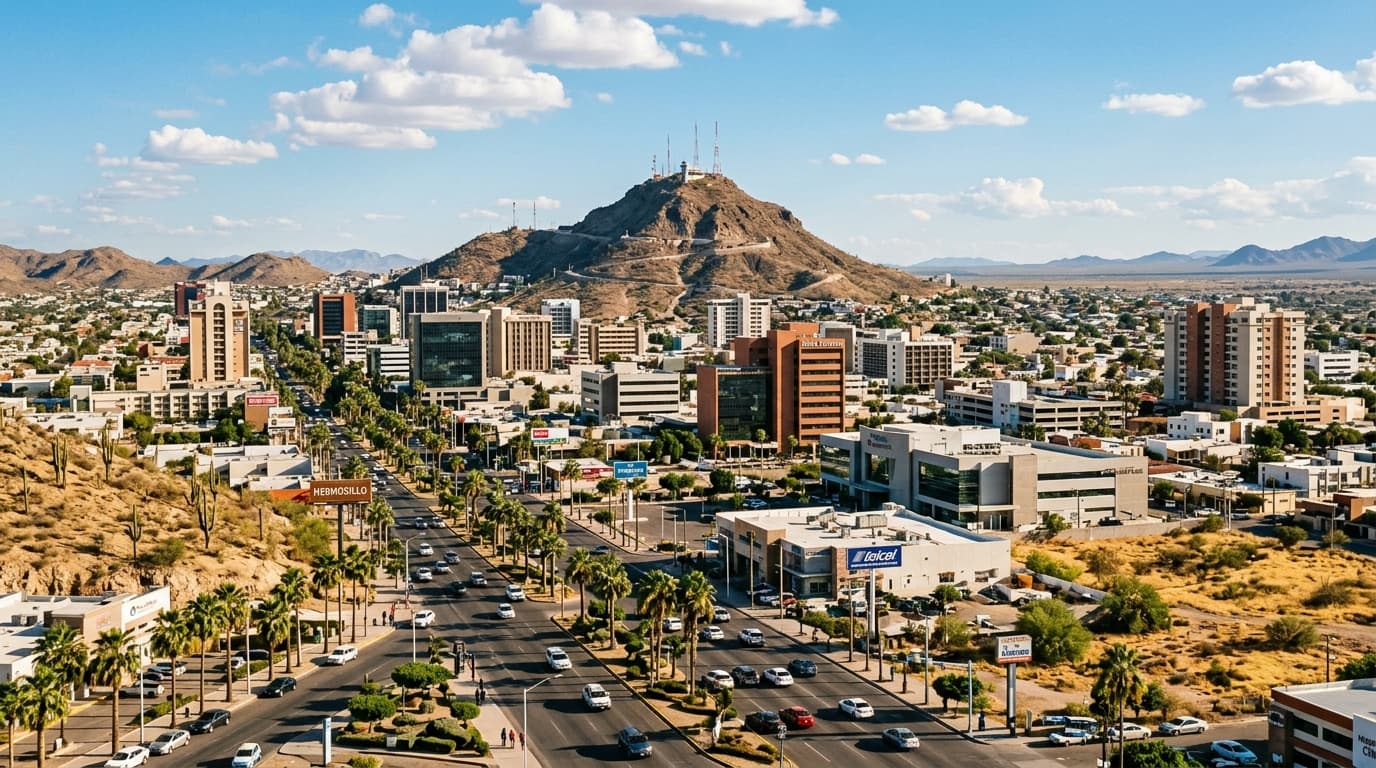
Hermosillo is not a holiday destination, and almost nobody drives to Mexico specifically to see it. But it is the single most important city on the Sonora corridor: the state capital, the biggest city between the border and Mazatlán, a serious manufacturing and business hub, and the overnight stop or supply run for essentially every other destination in this part of Mexico.
If you're driving to Kino Bay, San Carlos, Álamos, or continuing south to Sinaloa (which the US State Department's Mexico travel advisory lists as Level 4: Do Not Travel), you're going through Hermosillo. If you're doing business in northern Mexico, there's a good chance you're going to Hermosillo.
Either way the insurance requirement is the same: Mexican liability coverage from a Mexican-licensed insurer, from the moment you cross. Mexican federal law requires every vehicle on a federal highway, road or bridge to carry insurance covering damage to third parties (Ley de Caminos, Puentes y Autotransporte Federal, art. 63 Bis), and Baja Bound's FAQ says US and Canadian insurance is not considered proof of financial responsibility under Mexican law.
Which policy for Hermosillo
Baja Bound's quote form asks one territory question — "Are you only traveling to Baja or Sonora?" — and quotes either a Baja & Sonora policy or one for all of Mexico (Baja Bound lists a Baja & Sonora Saver discount).
Baja & Sonora covers the state of Sonora and the Baja peninsula. Hermosillo is the Sonora state capital, so it's covered.
The all-of-Mexico policy covers the whole country.
For a straightforward trip to Hermosillo and back, Baja & Sonora is sufficient.
For business travel, I'd lean to the all-of-Mexico policy, for a practical reason rather than a legal one: business trips change. The Baja & Sonora policy stops at the Sonora–Sinaloa line, and discovering that mid-trip means either driving uninsured or buying a second policy on the road. The premium difference is small against that risk. Ask Baja Bound for the all-of-Mexico quote before you leave rather than on the road.
Our Baja & Sonora vs all of Mexico — which policy covers Rocky Point guide covers the regional split.
The vehicle permit
Sonora runs its own temporary vehicle import programme, Only Sonora, for travel that stays inside the state: the permit costs USD 59.61 at the exchange rate on the day, is valid for up to 180 days in a 12-month period, and is paid at modules in Agua Prieta, Cananea and Empalme. Its requirements include a copy of the vehicle registration, the title, a current insurance policy, your passport, your driver's licence and, for foreigners, the migration form.
Confirm the current boundary at Banjercito when you cross, and understand where it ends. The free zone runs to roughly Empalme. If your trip continues south past that point, or east into southern Sonora toward Álamos, you move into TIP territory. Our Sonora Hassle-Free Zone guide covers exactly where that line falls and what happens if you cross it without a permit.
Beyond Sonora, a foreign vehicle needs the federal temporary import permit. The Consulate General of Mexico in Montreal's Traveling to Mexico by Land page says it can be obtained online from Banjercito 60 to 7 days ahead or at the border, that you need your passport, foreign driver's licence, migration document, title or registration in your name, lease or credit papers if applicable, a signed return declaration, a fee and a deposit by model year, and that an expired permit while the car is still in Mexico can mean impound and a fine.
The permit and the insurance are separate systems. Neither replaces the other.
You'll still want an FMM tourist permit for anything beyond a very short visit; it is applied for through INM.
The route from Nogales
The simplest drive in this pack.
Nogales → Hermosillo. About 175 miles, roughly 3 hours on Highway 15D — four-lane divided toll highway most of the way. Add the border crossing and figure 4 hours door to door.
There are two Nogales ports for passenger vehicles (DeConcini and Mariposa). Southbound waits are usually short, often under 20 minutes. The time cost at the border is the paperwork, not the queue — budget an hour if you're doing an FMM.
On the road:
- Fuel is available at intervals along 15D. Pemex stations dominate. Carry cash pesos — card acceptance is inconsistent at some stations and at toll booths.
- Speed limits are posted in kilometres and enforcement does happen on this corridor.
- Have documents accessible for any checkpoint you meet.
The Hermosillo approach and bypass are the only genuinely complicated navigation. The city has grown and the ring roads are busy. Have GPS running before you arrive.
The business travel angle
Hermosillo is a manufacturing and administrative centre, with automotive and aerospace industry, state government, and a large university. A meaningful share of foreign drivers arriving here are doing so for work rather than leisure, and business travel has its own considerations.
The US rental car problem
Most US rental companies restrict or prohibit taking their vehicles into Mexico. This catches business travellers repeatedly, because the instinct is to fly to Tucson or Phoenix, rent, and drive down.
Before you plan that:
- Check the rental agreement explicitly. Many companies prohibit Mexico entry outright. Doing it anyway can void the agreement and any coverage attached to it, leaving you personally exposed.
- Some companies permit it with prior authorisation and sometimes an additional fee, usually restricted to specific border states and specific vehicle classes.
- Rental company coverage generally ends at the border regardless. Even where Mexico driving is permitted, you still need a Mexican-licensed policy — the rental's own coverage doesn't satisfy Mexican law.
- Some agencies at border-area airports are more accustomed to this than others and can arrange it properly.
The cleanest options for business travel are usually to fly into Hermosillo directly and rent locally, or to drive your own vehicle with your own Mexican policy.
Insurance for a business trip
A few things worth confirming rather than assuming:
- Who will drive. Baja Bound's FAQ says other drivers are covered as long as they have a valid driver's license on their person, and you do not need to list additional drivers (Baja Bound FAQ). Drivers with Mexican licences are not covered. Make sure every colleague who drives carries their license.
- Company vehicles. If the vehicle is registered to a business rather than an individual, tell the broker — documentation requirements differ, and this also affects TIP paperwork if you're leaving the free zone.
- Commercial use is not covered (Baja Bound FAQ). Non-commercial buses and box trucks can be.
- Coverage limits. Business travel often means a newer or higher-value vehicle. The quote form offers a choice of two deductibles (price index); check which one is on your quote.
- Trip frequency. If you're crossing monthly, an annual policy is dramatically cheaper than repeated short-term purchases. Past roughly six weeks of cumulative coverage a year, the annual wins.
Hotels and the overnight stop
Hermosillo is the most common first-night stop for anyone driving deeper into Mexico.
What to look for:
Secure parking. The single most important feature for a driving stopover. Enclosed or gated parking, not street parking. Chain hotels near the highway generally have it; confirm when booking rather than on arrival.
Highway proximity. Staying near the 15D corridor rather than deep in the city centre saves you navigating Hermosillo traffic twice. For a pure stopover, that's the right trade.
Early departure. If you're continuing south, you want to leave early to reach the next stop in daylight. Check whether breakfast is available at the hour you'll actually leave, or plan to eat on the road.
Hermosillo has a good supply of business-class chain hotels precisely because of the industry here, which works in a road-tripper's favour — they're accustomed to guests arriving late and leaving early.
Fuel, food, and rest stops on the corridor
The Nogales–Hermosillo run is short enough that you don't need a plan, but a few specifics save aggravation.
Fuel. Pemex stations appear at reasonable intervals on 15D. A few habits worth adopting: watch the pump reset to zero before fuelling, state the amount in pesos rather than "fill it," and pay attention to which grade you're getting. Attendants pump for you — a small tip is customary. Carry cash; card readers are inconsistent and sometimes "not working" in a way that resolves if you have pesos.
Toll booths. Highway 15D is a toll road and the booths take cash reliably and cards unreliably. Keep pesos in small denominations accessible rather than buried in a bag.
Food. The corridor has roadside restaurants and the OXXO convenience chain at intervals. Magdalena and Santa Ana are the natural break points between Nogales and Hermosillo.
Restrooms. At the larger Pemex stations and the restaurants. Not universally at the smaller ones.
Timing. Leaving Nogales in the morning puts you into Hermosillo early afternoon with the whole day intact — which matters if you're continuing to Kino Bay or the coast rather than staying.
Continuing south — what changes
If Hermosillo is a stopover rather than a destination, know what shifts as you carry on.
Toward Guaymas, San Carlos, and Kino Bay: nothing changes. Still inside the free zone, still covered by a Baja & Sonora policy. These are comfortable half-day runs from the city.
Toward Álamos or Ciudad Obregón: you leave the free-circulation zone at km 98 of Highway 15 at Empalme. A vehicle permit becomes required — for travel that stays inside Sonora, the Only Sonora permit: USD 59.61, 180 days in a 12-month period, issued at the Banjercito modules in Agua Prieta, Cananea and km 98 Empalme (Sonora state government). Your insurance region may still be fine on a Baja & Sonora policy, but the customs requirement is separate and independent.
Toward Sinaloa — Los Mochis, Culiacán, Mazatlán: you leave both the free zone and a Baja & Sonora policy. You need a policy for all of Mexico plus a TIP. This is the transition that catches people, because it starts as a Sonora trip and grows. This route passes through Sinaloa, which the US State Department's Mexico travel advisory lists as Level 4: Do Not Travel. The same advisory says: "We highly recommend that you buy travel insurance before you travel."
The safest approach for anyone whose itinerary might extend: buy the all-of-Mexico policy and get the TIP at the border. Our Sonora Hassle-Free Zone guide maps out exactly where each line falls.
Hermosillo as a base
If you're spending time here rather than passing through, the city is a workable base for the Sonoran coast:
Kino Bay — about 65 miles west, roughly 1.5 hours on Highway 16. Comfortable day trip, and Hermosillo is where Kino residents do their real shopping. See our Kino Bay guide.
Guaymas and San Carlos — about 80 miles south, roughly 1.5 hours. See our San Carlos guide.
Puerto Peñasco (Rocky Point) — considerably further, and most Rocky Point traffic comes via Lukeville from Arizona rather than through Hermosillo. See our Rocky Point guide.
Álamos — about 230 miles south and east, roughly 4 hours. Note that Álamos is outside the free zone, so a TIP is required for that leg even though Hermosillo isn't. See our Álamos guide.
The city itself has full services: hospitals, major supermarkets, big-box retail, an international airport, and the parts and mechanical infrastructure that the smaller coastal towns lack. For anyone wintering on the Sonoran coast, Hermosillo is the place you go when you need something the beach town doesn't have.
The city itself
Not a tourist town, and it doesn't pretend to be. What's here:
- Plaza Zaragoza and the cathedral in the historic centre.
- The state museum and the university campus.
- Cerro de la Campana, the hill overlooking the city, with views across the valley.
- A serious food scene — Sonora is cattle country, and the beef here is the point. Carne asada in Hermosillo is a legitimate reason to stop.
Climate: Hermosillo is hot. It's one of the hottest cities in Mexico in summer, routinely extreme from June through September. Winter is mild and pleasant, which is when you'd want to be here anyway.
What drivers get wrong
Buying the Baja & Sonora policy, then extending the trip south. The policy stops at the Sinaloa line. For business travel especially, the all-of-Mexico policy is the safer buy.
Assuming the free zone means no insurance needed. It exempts the vehicle permit, not the insurance.
Assuming the free zone extends the whole state. It doesn't. Southern Sonora, including Álamos, is TIP territory.
Taking a US rental car across without checking. Most agreements prohibit it, and violating that voids your coverage.
Booking a hotel without confirming secure parking. The one feature that matters for a road stopover.
If something happens
Stay at the scene, call the claims number on your policy before moving the vehicle or agreeing to anything, don't admit fault, don't sign Spanish-language documents you can't read. Baja Bound's claims page lists the HDI and Chubb claim phone numbers.
Hermosillo specifics:
- For roadside help, Ángeles Verdes answer on 078; 911 is Mexico's emergency number.
- It's the best place in northern Sonora for mechanical work and parts availability — meaningfully better than the coastal towns.
- Remember that travel medical insurance is a separate purchase from your auto policy. The auto policy covers the vehicle and liability, not your health.
- Keep a printed copy of the policy in the vehicle.
Frequently asked questions
What insurance do I need to drive to Hermosillo?
Baja Bound's regional Baja & Sonora policy covers Hermosillo because it is the Sonora state capital. A policy for all of Mexico is the better choice for business travel or if your trip might continue south past the Sonora state line.
How far is Hermosillo from the Nogales border?
About 175 miles and roughly 3 hours of driving on Highway 15D, or about 4 hours door to door including the border crossing.
Do I need a vehicle permit to drive to Hermosillo?
Sonora's Only Sonora programme issues a temporary vehicle import permit for travel inside the state (USD 59.61, up to 180 days in a 12-month period, paid at modules in Agua Prieta, Cananea and Empalme). Confirm at Banjercito when you cross whether your route needs it.
Can I drive a US rental car to Hermosillo?
Usually not without permission. Most US rental companies restrict or prohibit taking vehicles into Mexico, and doing so can void the rental agreement and its coverage. Check with the rental company first and buy Mexican insurance separately regardless.
Are my colleagues covered if they drive?
Baja Bound's FAQ says other drivers are covered as long as they hold a valid driver's licence; they do not need to be listed. Commercial use is not covered.
Is Hermosillo a tourist destination?
Not really. It is the state capital and a major business and manufacturing hub, and most foreign visitors are there for work or passing through en route to the coast or southern Sonora.
Where do most drivers stop overnight on the Sonora corridor?
Hermosillo is the most common first-night stop for anyone driving deeper into Mexico, with a good supply of chain hotels with secure parking near the highway.
Does Hermosillo work as a base for visiting the Sonoran coast?
Yes. Kino Bay is about 1.5 hours west and Guaymas and San Carlos are about 1.5 hours south, so day trips from the city are practical.
Driving into Sonora? Get a Mexican car insurance quote from Baja Bound.
Related reading
- Sonora Hassle-Free Zone — what it covers and where it ends
- Driving to Kino Bay
- Driving to Álamos
- Driving to San Carlos, Sonora
- Driving to Mazatlán
- Do I need Mexican car insurance for a rental car?
Written from Rosarito, Baja California.