

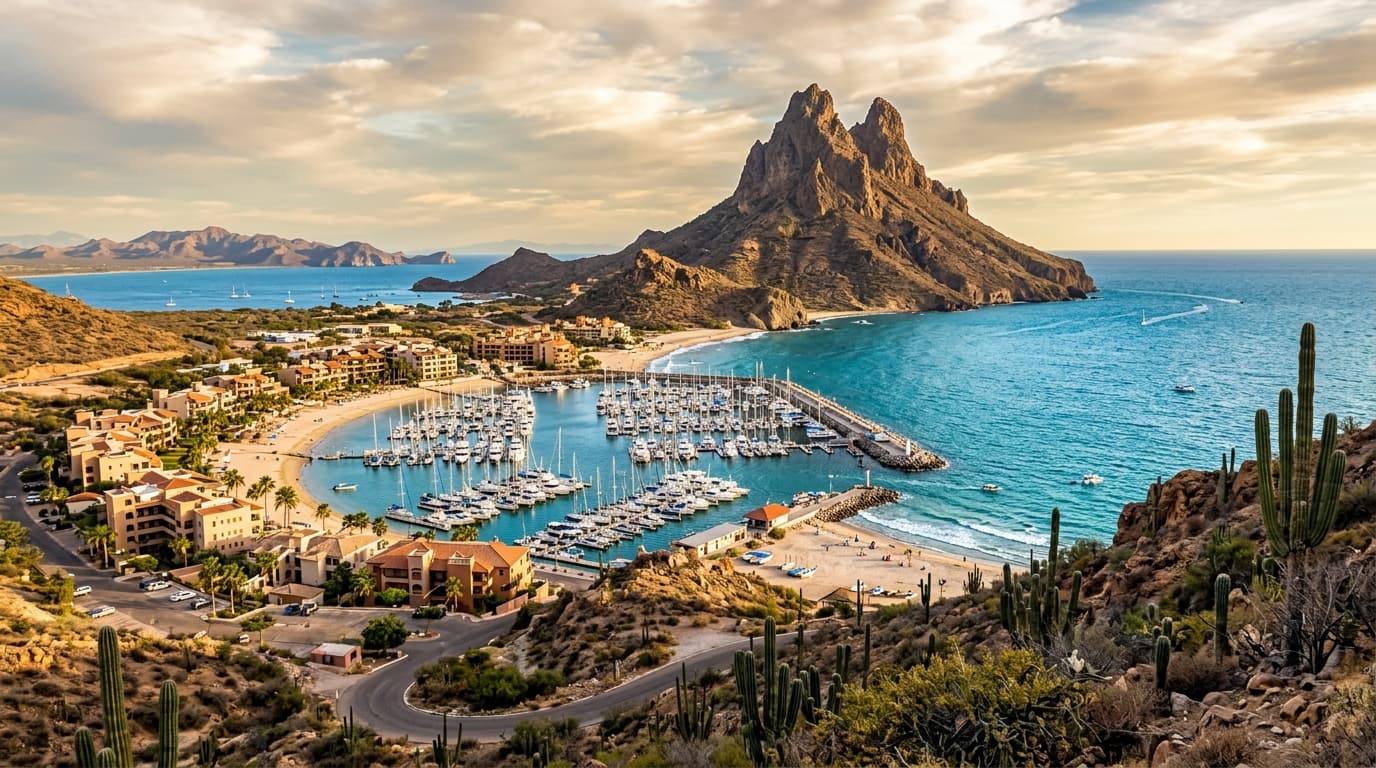
San Carlos is the Sonoran coast's quieter option. About 340 miles and roughly 7 hours from the Nogales crossing, it sits on the Sea of Cortez just west of Guaymas, tucked under the twin peaks of Cerro Tetakawi. Where Puerto Peñasco draws Arizona weekenders in volume, San Carlos draws people who stay — seasonal residents, boat owners, RV park regulars who've had the same spot for fifteen years.
It's also one of the few mainland snowbird destinations where you can legitimately buy the regional Baja & Sonora policy instead of the all-of-Mexico policy. That's worth real money over a season, and it's the single most useful thing to understand before you buy coverage.
The insurance advantage: the regional policy actually works here
Mexican auto policies are sold by region, and the regional ones are cheaper because they're limited.
Baja & Sonora covers the state of Sonora and the Baja peninsula. San Carlos is in Sonora, near Guaymas. So it's covered — a narrower regional product than the all-of-Mexico policy.
It does not cover San Carlos, and buying it for a Sonora trip is the classic expensive mistake. Baja and Sonora face each other across the Sea of Cortez, and the names get conflated constantly. They are separate regions with separate policies. The all-of-Mexico policy covers all of Mexico, including San Carlos.
For a snowbird whose season is San Carlos and nothing else, Baja & Sonora is the right product.
The one thing that changes the answer: if there is any chance you will continue south past the Sonora state line, ask for the all-of-Mexico quote before you leave: Sinaloa, the next state south, is listed as Level 4: Do Not Travel in the US State Department's Mexico travel advisory. The Baja & Sonora policy stops at the state line, and a lot of San Carlos regulars eventually take the drive further down the coast. Decide before you buy, not in February.
We cover the regional distinction in depth in Baja & Sonora vs all of Mexico — which policy covers Rocky Point.
The route from Nogales
Straightforward, and the shortest drive of any mainland snowbird destination.
Nogales → Hermosillo. About 175 miles, roughly 3 hours on Highway 15D. Four-lane toll highway, easy driving.
Hermosillo → Guaymas. About 80 miles, roughly 1.5 hours. The road meets the coast here.
Guaymas → San Carlos. About 10 miles, roughly 20 minutes west on the San Carlos road.
Total: roughly 340 miles, about 7 hours including the border.
This is a genuine one-day drive from Nogales, and from Tucson or Phoenix it's a comfortable single day door to door. That's part of the appeal — you're on the Sea of Cortez without the two-day commitment that Mazatlán or Puerto Vallarta demands.
Standard mainland advice still applies: cross in the morning, and don't be finishing the Hermosillo–Guaymas stretch after dark.
The paperwork
The vehicle permit
Sonora runs its own temporary vehicle import programme, Only Sonora, for travel that stays inside the state: the permit costs USD 59.61 at the exchange rate on the day, is valid for up to 180 days in a 12-month period, and is paid at modules in Agua Prieta, Cananea and Empalme. Its requirements include a copy of the vehicle registration, the title, a current insurance policy, your passport, your driver's licence and, for foreigners, the migration form. The free zone runs to km 98 of Highway 15 at Empalme.
Confirm the current terms at Banjercito when you cross, and whether your route and destination need the permit. The program's boundaries and conditions are set by Mexican authorities and are subject to change, and the details matter — including what happens if you decide mid-season to drive further south. Ask at the crossing rather than relying on what was true a few years ago.
Beyond Sonora, a foreign vehicle needs the federal temporary import permit. The Consulate General of Mexico in Montreal's Traveling to Mexico by Land page says it is obtained online from Banjercito 60 to 7 days ahead or at the border, and that an expired permit while the car is still in Mexico can mean impound and a fine.
What the permit does not do is replace insurance. Mexican liability coverage is required on federal roads and bridges, full stop. Mexican federal law requires every vehicle on a federal highway, road or bridge to carry insurance covering damage to third parties (Ley de Caminos, Puentes y Autotransporte Federal, art. 63 Bis), and Baja Bound's FAQ says US and Canadian insurance is not considered proof of financial responsibility under Mexican law. The permit is about vehicle importation paperwork, not about insurance. People conflate the two every season.
FMM tourist permit
For a stay of snowbird length, you need a tourist permit, applied for through INM. Confirm the dates granted and keep it with your passport.
Costs
For Baja Bound reference prices on a passenger vehicle with Baja & Sonora territory, see the price table; Baja Bound also offers 3-month, 6-month and annual terms. For a four-month season, compare the cost of a longer-term policy against short-term coverage for your own vehicle.
Full coverage rather than liability-only is worth it here for a specific reason: San Carlos involves boat ramps, marina areas, gravel and dirt access roads to the better beaches and viewpoints, and a lot of trailer manoeuvring. Minor damage is common.
Two exclusions from Baja Bound's FAQ matter in a beach town: vehicles not on conventional roads (the beach, for example) are not covered, and neither is racing or off-road use.
Boats and trailers — read this before you tow
San Carlos is a boating town, and this is where insurance gets misunderstood.
Your auto policy does not cover your boat. Watercraft is a separate product with separate coverage. If you're bringing a boat, you need watercraft coverage in addition to auto coverage. Baja Bound's watercraft page says the policy is liability cover, paying for damage or injury you cause to others; physical damage and theft of your boat are not covered, and passenger medical payments are excluded. Mexico's navigation law requires vessels to carry civil-liability insurance (Ley de Navegación y Comercio Marítimos, art. 176).
Ask Baja Bound in writing whether the trailer is covered on the auto policy, with the trailer described, before you tow it across.
The tow vehicle's coverage doesn't extend to what it's towing just because they're physically connected. Ask your broker to confirm all three — vehicle, trailer, and watercraft — in writing.
This catches people out every season, and it's an expensive discovery to make at a boat ramp. Our RV and motorhome coverage guide covers the equivalent issue for motorhomes and towed vehicles.
San Carlos vs Rocky Point
Both are Sonoran beach destinations reachable on Baja & Sonora coverage. They're quite different places.
Distance from Arizona. Rocky Point is closer to Phoenix and Tucson — roughly 4 to 4.5 hours from Phoenix via Lukeville. San Carlos is about 7 hours from Nogales, so figure a longer day from either Arizona city.
Crowd and rhythm. Rocky Point is a weekend destination with a large short-stay population, a big spring break presence, and correspondingly busy weekends. San Carlos skews toward longer stays and a more settled seasonal community. Quieter, older on average, more residential.
Water orientation. San Carlos is built around the marina, sportfishing, and diving. The Sea of Cortez here is deep and clear, and the boating infrastructure is the town's centre of gravity. Rocky Point is more beach-and-sand oriented.
Crossing. Rocky Point uses Lukeville. San Carlos uses Nogales, a larger crossing; check the hours of either port on cbp.gov before you go.
Which to choose: if you want a beach weekend a few times a winter, Rocky Point's proximity wins. If you want to settle somewhere for four months with a boat, San Carlos is the better fit.
Our Rocky Point driving guide and Phoenix to Rocky Point route guide cover the alternative in detail.
Where snowbirds stay
Marina area — condos and homes around the marina and the country club area. The centre of the boating community. Assigned parking is standard.
Along the bay — the strip between Guaymas and San Carlos proper has established residential development, much of it foreign-owned.
RV parks — San Carlos has long-standing RV parks that have served the same returning residents for decades. Winter spots at the established parks fill early. If this is your first season, reserve well ahead of October — the good parks are booked by returning regulars who reserve a year out.
Guaymas — the working port city 10 miles east. Larger, more services, more Mexican, cheaper. Some seasonal residents base here and drive to San Carlos.
Long-stay parking
Less of an issue than in the colonial cities. Most San Carlos properties are newer construction with driveways or assigned spaces. The exception is if you're bringing both a vehicle and a trailered boat — confirm there's room for both, and ask about trailer storage specifically if you'll be leaving the boat in the water.
Fishing, boating, and the season's rhythm
San Carlos is organised around the water more than most Mexican beach towns, and the calendar reflects it.
The marina is the centre of the community. Slips, dry storage, fuel, and the services that go with them. If you're bringing a boat, sort the berth before you sort the accommodation — the good spots go to returning regulars.
Sportfishing runs year-round with seasonal targets. The Sea of Cortez here is deep and drops off quickly, which is what makes the fishing what it is.
Diving and snorkelling around the rock formations and the islands. Water clarity is better in the cooler months.
The launch ramps are where the trailer question becomes real. Manoeuvring a trailer on a wet concrete ramp with an audience is how minor damage happens, and it's a good reminder to have confirmed in writing that the trailer is covered on your policy.
Winter water temperature is cool enough that most people wear a wetsuit for extended time in. It warms substantially by late spring.
What a San Carlos season costs to drive
Rough planning numbers, separate from accommodation:
Getting there and back: fuel for roughly 680 miles round trip from Nogales — the shortest border-to-destination run of any mainland snowbird destination — plus modest tolls on Highway 15D. This is the cheapest drive of any destination in this pack.
Insurance: a Baja & Sonora policy covering the season and both drives, which works here unlike at the Sinaloa and Jalisco destinations.
FMM: a per-person fee at the crossing.
Vehicle permit: the Only Sonora permit if your route needs it, at USD 59.61 (Sonora state government).
No overnight hotel required on the drive, since it's a single day from Nogales and a long single day from Phoenix or Tucson.
That combination — short drive, cheap regional policy, no overnight stop — makes San Carlos one of the lowest-friction snowbird destinations in Mexico to reach by car. It's a large part of why the same people come back for twenty years.
The season
- October–November — arrivals begin as the summer heat and humidity break.
- December–March — peak. Largest seasonal population, best weather, fullest calendar of fishing tournaments and community events.
- April–May — thinning out, still pleasant, water warming.
- June–September — hot and humid. The foreign population drops off sharply.
Most seasonal residents arrive in November and leave in March or April.
Guaymas — the services town next door
San Carlos is small. Guaymas, 10 miles east, is where a lot of the practical business of a season gets done, and it's worth knowing what's there.
Mechanical work and parts. Guaymas is a working port city with real automotive infrastructure. Labour is inexpensive; parts for less common North American models can take days to source. Service the vehicle before you leave home rather than planning to sort it here.
Shopping. Larger supermarkets, hardware, and general retail. San Carlos has groceries and convenience but a limited range.
Fuel. Cheaper and more plentiful in Guaymas than in San Carlos.
The 20-minute run between the two is the most-driven stretch for most seasonal residents, and it's ordinary two-lane highway driving. Watch for topes at the edges of both towns.
What San Carlos snowbirds get wrong
San Carlos is Sonora, not Baja.
Buying the Baja & Sonora policy, then deciding to drive to Mazatlán. The policy stops at the state line. If there's any chance of continuing south, buy the all-of-Mexico policy up front.
Assuming the Sonora permit arrangement means no insurance needed. A vehicle permit is customs paperwork, not insurance. Every vehicle on a federal highway, road or bridge in Mexico must carry third-party liability insurance (art. 63 Bis).
Assuming the auto policy covers the boat. It doesn't. Watercraft is separate.
Assuming the auto policy covers the trailer. Ask Baja Bound in writing, with the trailer described.
Booking an RV spot late. The established parks are largely reserved by returning regulars. Book early.
Buying short-term coverage for a four-month stay. Compare it against a longer-term policy first.
If something happens
Same fundamentals as anywhere: stay at the scene, call the claims number on your policy before moving the vehicle or agreeing to anything, don't admit fault, don't sign Spanish documents you can't read. Baja Bound's claims page lists the HDI and Chubb claim phone numbers.
San Carlos specifics:
- For roadside help, Ángeles Verdes answer on 078; 911 is Mexico's emergency number.
- Guaymas is the nearest full-service city for mechanical work and parts.
- The San Carlos access roads and beach tracks are where most minor vehicle damage happens. Gravel, sand, and steep ramps.
- If you're on the water, marine emergencies are a different system entirely from roadside assistance. Know your marina's procedures.
- Travel medical insurance is a separate purchase from the auto policy; the State Department's advisory says: "We highly recommend that you buy travel insurance before you travel."
- Keep printed copies of the policy and FMM in the vehicle.
Frequently asked questions
Does a Baja & Sonora policy cover San Carlos?
Yes. San Carlos is in the state of Sonora, near Guaymas, so Baja Bound's regional Baja & Sonora policy covers it.
Do I need all-of-Mexico insurance for San Carlos?
Only if the trip might continue south of Sonora. The Baja & Sonora policy stops at the Sonora state line, so a run into Sinaloa needs the all-of-Mexico quote.
How far is San Carlos from the Nogales border?
About 340 miles and roughly 7 hours of driving, south on Highway 15 through Hermosillo to Guaymas, then a few miles west to San Carlos.
Do I need a vehicle permit to drive to San Carlos?
Sonora's Only Sonora programme issues a temporary vehicle import permit for travel inside the state (USD 59.61, up to 180 days in a 12-month period, paid at modules in Agua Prieta, Cananea and Empalme). Confirm at Banjercito when you cross whether your route needs it.
Does my auto policy cover my boat?
Baja Bound sells watercraft cover separately. Its watercraft page says the policy is liability cover for damage or injury you cause to others; physical damage and theft of your boat are not covered, and passenger medical payments are excluded. Ask Baja Bound in writing whether your trailer is covered.
How does San Carlos compare to Rocky Point?
San Carlos is quieter, more expat-heavy, and more oriented toward boating and sportfishing. Rocky Point is closer to Arizona, busier, and draws a larger weekend and spring break crowd.
Is San Carlos good for RVs?
Yes. It has long-established RV parks that fill with returning seasonal residents, and winter spots book well in advance.
What months are peak season in San Carlos?
November through March, with the largest seasonal population from January through March. Summer is hot and humid and the foreign population thins considerably.
Should I buy Baja & Sonora or all of Mexico for San Carlos?
Baja & Sonora is sufficient if San Carlos is your destination and you stay in Sonora. Buy the all-of-Mexico policy if you plan to continue south of Sonora at any point in the season; Sinaloa, the next state south, is listed as Level 4: Do Not Travel by the US State Department (advisory).
Coming from further than Arizona
San Carlos is an easy day from Tucson or Phoenix, but it also works as a first stop — or a whole season — for drivers coming much further. Midwest snowbirds routing through Nogales pass the San Carlos turnoff on the way south, and a fair number stop and never continue. Our Minnesota to Mexico corridor guide covers the run down from the Plains and the two corridor options.
San Carlos on the itinerary? Get a Mexican car insurance quote from Baja Bound.
Related reading
- Baja & Sonora vs all of Mexico — which policy covers Rocky Point
- Driving to Puerto Peñasco / Rocky Point
- Phoenix to Rocky Point route guide
- RV and motorhome Mexican car insurance
- Driving to Mazatlán for the winter
- Driving to Hermosillo
- Long-term Mexican car insurance for snowbirds
Written from Rosarito, Baja California.