
Mexican Car Insurance for Driving to San Miguel de Allende 2026: Texas Route and Coverage Guide

By Scott Tobin · · 12 min read
Last updated:
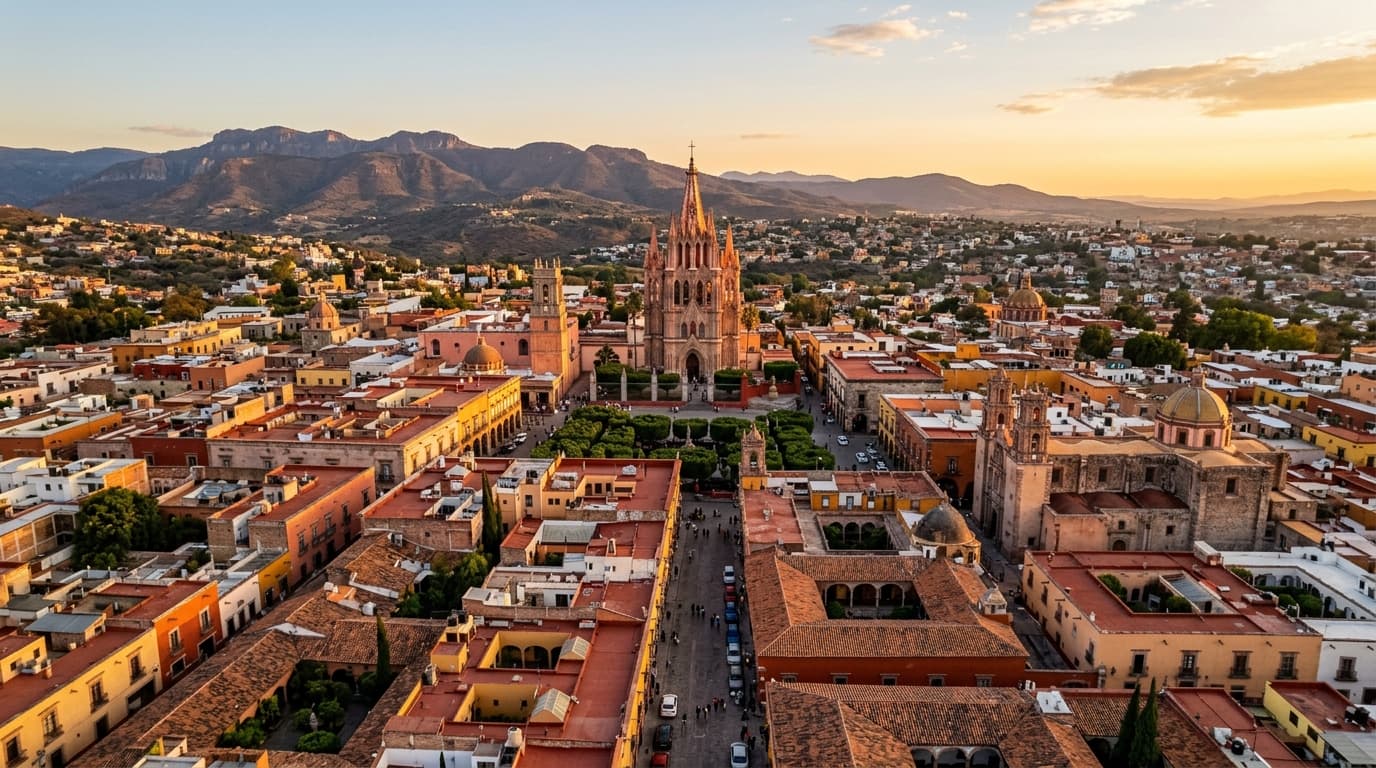
San Miguel de Allende is the outlier among snowbird destinations. It isn't on a beach, it sits at 6,400 feet in the central highlands, and its winter appeal is architectural and cultural rather than tropical. It also has one of the largest and oldest US and Canadian communities anywhere in interior Mexico, and for drivers coming from Texas and the Midwest it's substantially closer than the Pacific coast.
The coverage requirement is simple: San Miguel is in Guanajuato, deep in the interior, so you need Nationwide insurance plus a TIP and an FMM. What makes this destination different is the route — most drivers come through Texas rather than Arizona — and the practical realities of parking a foreign-plated vehicle in a UNESCO World Heritage colonial city.
Why San Miguel needs Nationwide coverage
Regional Mexican policies are built around the border free zones. Baja Only covers the peninsula. Sonora Only covers the Sonora corridor. Neither comes within several hundred miles of Guanajuato.
San Miguel de Allende is roughly in the geographic centre of the country. Getting there means crossing multiple states regardless of which border you use — Tamaulipas, Nuevo León, and San Luis Potosí on the Texas route; Sonora, Sinaloa, Nayarit, and Jalisco on the western route. Only a Nationwide policy covers that.
There is no cheaper regional option that reaches the colonial highlands. Nationwide is the product.
The Laredo route — the standard approach
For most US drivers, and for essentially everyone coming from Texas, the Midwest, or the eastern half of the country, Laredo is the crossing.
Laredo → Monterrey. About 150 miles, roughly 2.5 hours on Highway 85D. Monterrey is a large industrial city; the ring roads around it are busy and worth navigating with GPS.
Monterrey → San Luis Potosí. About 320 miles, roughly 4.5 hours on Highway 57D. Straightforward high-desert toll highway driving.
San Luis Potosí → San Miguel de Allende. About 120 miles, roughly 2 hours, coming in via Dolores Hidalgo or via Querétaro depending on the routing.
Total: roughly 700 miles, about 11 hours of driving.
That's a hard one-day push or a comfortable two-day trip. Many drivers overnight in Monterrey or Matehuala. The same daylight-driving advice applies here as everywhere in Mexico: plan to be off the highway before dark.
The Laredo crossing itself is one of the busiest commercial ports on the border. Passenger vehicle crossings are separate from the commercial lanes, and the Banjercito office for TIP and FMM paperwork is on the Mexican side. Budget an hour for paperwork even if the vehicle queue is short.
If you're routing through Texas, our Texas drivers guide covers the crossing options in more detail.
The Nogales alternative
There is a western route: Nogales → Hermosillo → Mazatlán → Guadalajara → San Miguel. It runs roughly 24 hours of driving.
That's more than double the Laredo route. It only makes sense in two situations:
You're already coming from the west. A driver from Arizona, California, or the Pacific Northwest may find Nogales the natural crossing regardless of the extra distance, because getting to Laredo means crossing the US first.
You want the coastal detour. Some snowbirds deliberately route down the Pacific corridor, spend time in Mazatlán or Puerto Vallarta, then cut inland to San Miguel for the back half of the season. If you're doing a multi-stop winter, the western route buys you those stops.
For a straight shot to San Miguel from anywhere east of the Rockies, take Laredo.
The paperwork
TIP (Temporary Vehicle Import Permit)
Required, without exception. San Miguel is nowhere near a free zone.
Get it from Banjercito at the crossing or apply online in advance. Bring vehicle registration or title, passport, driver's licence, and a credit card in the same name as the registration. There's a fee plus a refundable deposit that scales with vehicle age.
Cancel the permit when you leave the country. Failing to cancel forfeits the deposit and complicates future entries. This is the most common first-year mistake and it's entirely avoidable — stop at Banjercito on the way north.
FMM tourist permit
Required for a season-length stay. Get it at the crossing with the TIP. Check the dates you're granted before leaving the border, and keep the document with your passport for the whole stay.
Costs and policy length
Mid-value vehicle ($20,000-$40,000), full coverage, Nationwide:
- 1 week: $95-135
- 2 weeks: $175-240
- 1 month: $200-280
- 3 months: $340-450
- Annual: $400-500
San Miguel stays skew long. A lot of people come for three months and end up extending, and a meaningful share of the community eventually shifts from seasonal to year-round. If there's any chance your stay runs past three months, buy the annual up front — it's cheaper than extending short-term coverage twice and it removes the risk of an accidental lapse.
Full coverage rather than liability-only is the sensible default here for a specific reason: the drive is 700 miles each way through unfamiliar terrain, and the in-town driving is on narrow cobblestone streets with stone kerbs and tight corners. Cosmetic damage is common. Liability-only leaves all of that on you.
See our long-term snowbird insurance guide for the annual-versus-monthly breakdown, including cancellation terms and seasonal-use structures.
The altitude — and what it actually means in January
San Miguel sits at roughly 6,400 feet. This surprises people who assume "Mexico" means "warm."
Winter days are typically mild, dry, and intensely sunny. Winter nights get cold — genuinely cold, not just cool. The dry highland air sheds heat fast after sunset.
The practical problem is that many colonial houses in San Miguel were not built with heating. Thick stone and adobe walls hold cool well, which is wonderful in May and unpleasant in January. Long-stay renters routinely underestimate this.
If you're booking a season:
- Ask specifically what heating exists. Fireplaces are decorative as often as functional. Portable electric heaters are common and are a real factor in the electricity bill.
- Ask about hot water reliability and capacity.
- Sun exposure matters more than in a tropical destination. A house that gets direct afternoon sun is materially warmer at night.
Vehicle-wise, altitude has minor effects: naturally aspirated engines lose some power, and if you've come from sea level you'll notice it on the climbs. Nothing that requires preparation, just an adjustment.
Driving and parking in a colonial city
This is where San Miguel differs most from a coastal destination.
The centro histórico is a UNESCO World Heritage site. The streets are narrow, cobblestoned, frequently one-way, and often steep. They were laid out for animals and carts. Large pickups and full-size SUVs — the vehicles a lot of North American snowbirds drive — are genuinely difficult to manoeuvre in the historic core.
Parking is the number one practical issue for driving snowbirds here. Many colonial houses have no garage and no off-street space at all. Street parking in the centro is limited and competitive.
Before committing to a long rental:
- Confirm a dedicated parking space in writing. Not "parking nearby," not "street parking usually available."
- If the property has a garage, ask for the entrance dimensions. Colonial-era garage doors defeat full-size trucks routinely.
- Consider whether basing slightly outside the historic core — where properties are newer and driveways exist — suits you better. Many long-term residents do exactly that and walk or taxi into the centre.
Once you're settled, a lot of residents drive very little day to day. The centre is walkable, and taxis are inexpensive. The car earns its keep for supermarket runs, trips to Querétaro (about an hour, with the nearest major airport and big-box retail), the Guanajuato city day trip, and the drive home in spring.
Day trips — where the car earns its keep
San Miguel sits in the middle of the most concentrated cluster of colonial cities in Mexico, and this is the real argument for driving down rather than flying.
Querétaro — about an hour southeast. The nearest major city: full hospital infrastructure, big-box retail, an international airport with more North American connections than San Miguel's regional options, and a UNESCO historic centre of its own. Most San Miguel residents make this run regularly.
Guanajuato city — about 1.5 hours west. Tunnels under the city, the university, the mummy museum, and a completely different colonial character. A standard day trip.
Dolores Hidalgo — about 40 minutes north. Ceramics, ice cream in improbable flavours, and the starting point of Mexican independence.
Pozos — a semi-restored former mining town about 45 minutes away, quiet and strange in a good way.
Guadalajara and Lake Chapala — about 4 hours west. Some San Miguel snowbirds split a season between the two, which is straightforward on a Nationwide policy. Our Lake Chapala guide covers that end.
Mexico City — about 3.5 to 4 hours southeast. Doable as an overnight rather than a day trip. Driving inside Mexico City is its own subject and many residents prefer to take the bus and skip the parking problem entirely.
All of it is covered by the same Nationwide policy, which is part of why the annual makes sense here even though in-town driving is minimal.
Money and practicalities for a season
Banking. Notify your bank before you leave. ATMs attached to established banks in San Miguel are the normal way to get pesos. Foreign transaction fees on the wrong card add up over four months.
Cash. San Miguel has a well-developed card economy by Mexican standards, but markets, small restaurants, and tradespeople are cash. Carry more than you would at home.
Utilities on a rental. Ask what's included. Electricity for portable heaters in January is a genuine variable, and gas for hot water in an old house can surprise people.
Medical. San Miguel has private clinics and English-speaking practitioners for routine care. Anything serious means Querétaro, an hour away, which has full major-hospital facilities. Travel medical insurance is a separate purchase from your auto policy and is not optional for a season-length stay.
Altitude adjustment. If you're arriving from sea level, give yourself a few days before doing anything strenuous. 6,400 feet is enough to notice.
The community and the season
San Miguel has one of the longest-established foreign communities in Mexico, dating back decades. It supports English-language services, a substantial arts and cultural infrastructure, a well-known library and cultural centre, a busy calendar of festivals, and a dense volunteer and charity network.
The population profile is different from a beach town. It skews toward people who came for the architecture, the arts scene, and the climate rather than the ocean, and a higher-than-typical share are full-time residents rather than seasonal.
Season rhythm:
- October–November — season begins, weather turns dry and clear.
- December–January — peak, plus a large domestic Mexican influx over the holidays. The Christmas and New Year period is the busiest of the year.
- February–March — the most comfortable stretch for most residents.
- Semana Santa (spring) — major domestic tourism week with significant religious processions.
Note that San Miguel is a substantial destination for Mexican tourists as well as foreign ones, which means holiday weekends fill the town regardless of the snowbird calendar.
What San Miguel snowbirds get wrong
Assuming a regional policy covers the interior. It doesn't. Nationwide only.
Skipping the TIP. Guanajuato is deep mainland. No TIP means the vehicle is at risk.
Not cancelling the TIP on the way home. Deposit forfeited, future trips complicated.
Underestimating the cold. A January night at 6,400 feet in an unheated stone house is a real experience. Ask about heating before you book.
Bringing a full-size truck without checking parking. The most common practical regret among first-season drivers here.
Buying three months of short-term coverage and then extending. Extending twice usually costs more than the annual would have.
Driving the last leg after dark. The San Luis Potosí to San Miguel stretch has unlit sections and the approach roads into town are narrow.
If something happens
The fundamentals don't change: stay at the scene, call the claims number on your policy before moving the vehicle or agreeing to anything, don't admit fault, don't sign Spanish-language documents you can't read.
Route and destination specifics:
- Green Angels (Ángeles Verdes) patrol the federal toll highways and provide free roadside assistance. They cover the 57D corridor.
- The Monterrey ring roads are the most complex driving on the Laredo route. Have navigation running before you get there.
- San Miguel has private hospital and clinic infrastructure, and Querétaro — about an hour away — has full major-hospital facilities.
- Cobblestone damage (tyres, wheels, suspension) is the most common non-collision vehicle complaint in town. Full coverage matters more here than the destination's gentle pace suggests.
- Keep printed copies of the policy, TIP, and FMM in the vehicle.
Frequently asked questions
What insurance do I need to drive to San Miguel de Allende?
Nationwide coverage. San Miguel is in Guanajuato, deep in the interior highlands, so regional Baja Only and Sonora Only policies do not apply.
What is the fastest route to San Miguel de Allende from the US?
Laredo to Monterrey to San Luis Potosí to San Miguel — about 700 miles and roughly 11 hours. It is the shortest and most direct route for most US drivers.
Do I need a TIP for San Miguel de Allende?
Yes. San Miguel is far outside any free zone, so a Temporary Vehicle Import Permit from Banjercito is required for a foreign-plated vehicle.
How high is San Miguel de Allende and does it get cold?
About 6,400 feet. Winter days are mild and sunny, but nights get genuinely cold and many older colonial houses have little or no heating.
Is the Nogales route to San Miguel worth taking?
It is roughly 24 hours of driving versus about 11 via Laredo, so it is only worth it if you are already coming from the west or want to route through Guadalajara. Most drivers use Laredo.
Do I need a car in San Miguel de Allende?
The historic centre is walkable and many residents get by without driving daily, but a car is useful for reaching Querétaro, the airport, larger supermarkets, and day trips.
Is parking difficult in San Miguel?
Yes in the centro histórico. Streets are narrow, cobblestoned, and often one-way, and many colonial houses have no garage. Confirm dedicated parking before signing a long rental.
How large is the expat community in San Miguel de Allende?
It is one of the largest and longest-established foreign communities in interior Mexico, with English-language services, arts organisations, and a substantial seasonal winter population on top of year-round residents.
Before you load the car, Start a Mexican insurance quote.
Related reading
- Mexican auto insurance for San Miguel de Allende
- Mexican auto insurance for Texas drivers
- Driving to Lake Chapala and Ajijic
- Snowbird driving from Minnesota to Mexico
- Long-term Mexican car insurance for snowbirds
- Driving to Mexico for the winter — what you need to know
Written from Rosarito, Baja California.