
Mexican Car Insurance for Driving to Lake Chapala and Ajijic 2026: Snowbird Guide

By Scott Tobin · · 12 min read
Last updated:
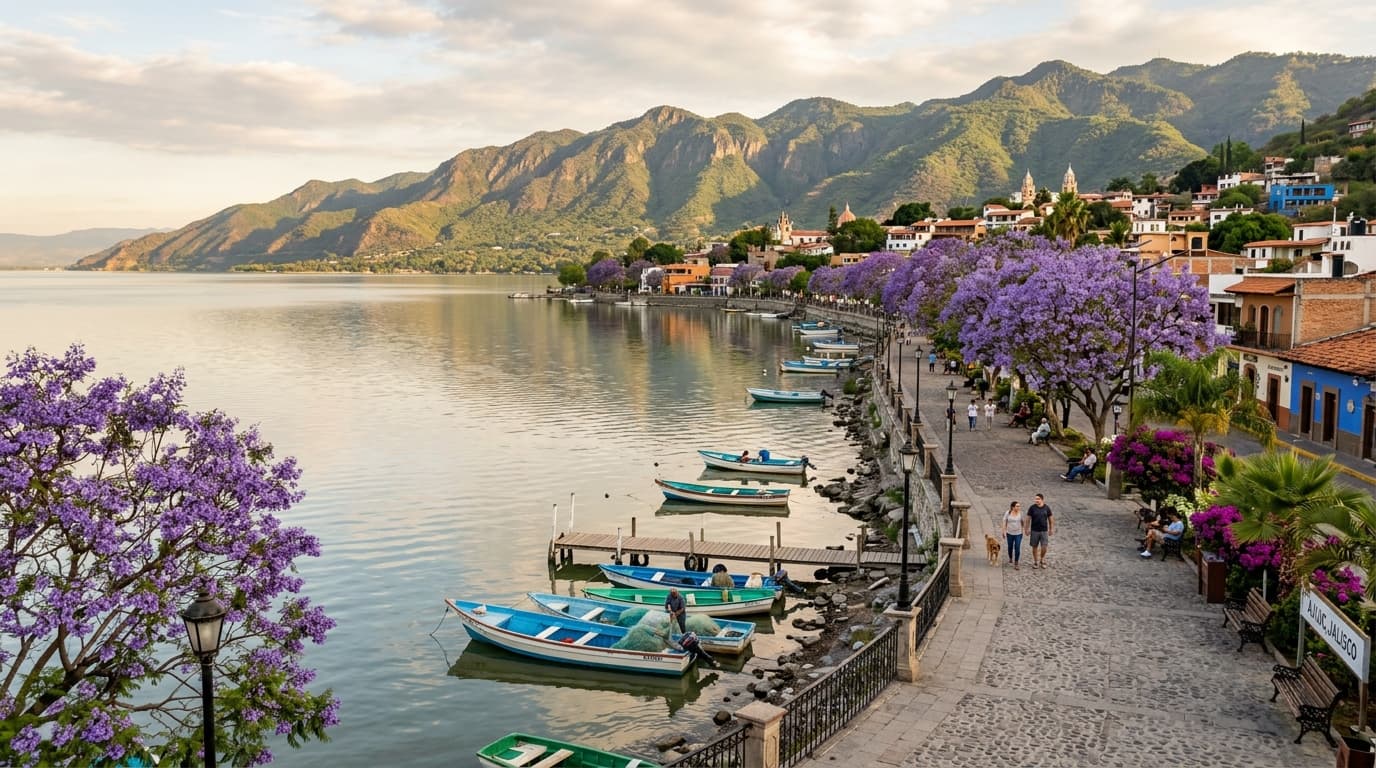
Lake Chapala is the largest lake in Mexico, and the string of villages along its north shore — Chapala, Ajijic, San Antonio Tlayacapan, San Juan Cosalá, Jocotepec — hosts what is generally reckoned to be the largest concentration of North American residents anywhere in the country. In high season the foreign population across Lakeside is commonly put well above 15,000.
What draws people is the climate. Lakeside sits at roughly 5,000 feet in the Jalisco highlands, and the combination of altitude, latitude, and the lake's moderating effect produces one of the mildest year-round climates in Mexico. It's the reason stays here run longer than at beach destinations — four to six months is normal, and a large share of seasonal residents eventually become full-time ones.
For insurance, it's mainland interior: Nationwide coverage, plus a TIP and an FMM.
Why Lakeside requires Nationwide
The regional Mexican policies exist to serve the border free zones. Baja Only covers the peninsula. Sonora Only covers the Sonora corridor from Arizona. Lake Chapala is roughly 1,200 miles from Nogales, in the interior of Jalisco.
Getting there crosses Sonora, Sinaloa, Nayarit, and Jalisco. Only Nationwide covers that, and only Nationwide covers you once you arrive.
There's a secondary reason Nationwide matters at Lakeside specifically: people here drive. The villages are strung along the lake shore, Guadalajara is 45 minutes away and is where the serious shopping, medical specialists, and airport are, and day trips to Puerto Vallarta, Guanajuato, and the tequila region are all common. A Lakeside season involves more genuine road mileage than a beach season where the car mostly sits.
The route from Nogales
Most driving snowbirds reach Lakeside via the Pacific corridor and cut inland at Guadalajara.
Nogales → Mazatlán. About 900 miles, roughly 14 hours, on Highway 15/15D through Hermosillo, Guaymas, Los Mochis, and Culiacán. This is the long day.
Mazatlán → Guadalajara. About 320 miles, roughly 5.5 hours, continuing south through Tepic and then inland and up into the highlands.
Guadalajara → Chapala / Ajijic. About 30 miles, roughly 45 minutes, south on the Chapala highway.
Total: roughly 1,200 miles, about 20 hours of driving.
Practically nobody does this in one push. The standard is two long days with an overnight in Mazatlán, or three more relaxed days stopping in Guaymas or San Carlos and then Mazatlán. Our Mazatlán guide covers that overnight in detail.
Drivers coming from Texas or the eastern US sometimes route through Laredo instead — Laredo → Monterrey → San Luis Potosí → Guadalajara. That's a legitimate alternative and can be shorter depending on your starting point.
The Guadalajara approach
The last hour is the trickiest part of the drive. Guadalajara is Mexico's second-largest metropolitan area, and the ring roads and periférico are busy, fast, and unforgiving if you miss an exit. Have navigation running and, if you can, time your arrival outside rush hours.
Once you're south of the city and onto the Chapala highway it's a straightforward run down to the lake.
Daylight driving
Same rule as the rest of the mainland: finish before dark. The Highway 15 corridor has livestock, unlit vehicles, and limited shoulders, and the climb into the highlands has sections you don't want to meet for the first time at night.
The paperwork
TIP (Temporary Vehicle Import Permit)
Required. Lakeside is deep mainland, nowhere near a free zone.
Obtain it from Banjercito at the crossing or apply online in advance. You'll need vehicle registration or title, passport, driver's licence, and a credit card in the same name as the registration. Expect a fee plus a refundable deposit scaled to the vehicle's age.
Cancel the TIP when you leave Mexico. Not doing so forfeits the deposit and creates problems for future entries.
One Lakeside-specific note: because so many seasonal residents here eventually transition to full-time residency, the TIP question comes up more often than elsewhere. The permit is tied to your tourist status. If you change immigration status, the vehicle's status has to be handled too — that's a conversation for a Mexican immigration specialist, not something to improvise.
FMM tourist permit
Required. Get it at the crossing with the TIP. Confirm the dates granted before leaving the border, and keep it with your passport — you need it to leave.
For a four-to-six-month stay, pay attention to the permitted duration rather than assuming you have the maximum.
Costs and why the annual almost always wins here
Mid-value vehicle ($20,000-$40,000), full coverage, Nationwide:
- 1 week: $95-135
- 2 weeks: $175-240
- 1 month: $200-280
- 3 months: $340-450
- Annual: $400-500
Lakeside stays are the longest of the major snowbird destinations. At four months you're at or past the annual price buying short-term. At six months it's not a close call.
There's also a behavioural argument. Lakeside is the destination where seasonal visitors most often extend — the climate is genuinely comfortable, the community is large, and "we'll stay another month" is a common story. An annual policy removes the risk of an unnoticed lapse when plans slip, which is exactly the scenario that leaves people uninsured without realising it.
Full coverage rather than liability-only is the right default given the mileage a Lakeside season involves, plus the Guadalajara driving.
Our long-term snowbird insurance guide covers annual structures, renewal terms, and mid-policy cancellation.
Chapala, Ajijic, and the villages
The area is collectively "Lakeside," and the distinctions matter when you're choosing where to base.
Chapala is the largest town and the municipal seat. It has the government offices, the bigger markets, the bus station, and a long lakefront malecón. More Mexican, less foreign-oriented, more services.
Ajijic is the village a few miles west and is the epicentre of the foreign community. Cobblestone streets, a well-known village plaza, a dense cluster of restaurants, galleries, and English-language services, and the highest concentration of North American residents. It's smaller than Chapala but it's where most newcomers land.
San Antonio Tlayacapan sits between the two and has absorbed a lot of the newer residential development.
San Juan Cosalá and Jocotepec are further west, progressively quieter and less expensive, with more of a Mexican village character.
The practical driving consideration: Ajijic's village core has narrow cobblestone streets, and the carretera — the single main road running along the lake through all the villages — is the spine of the whole area and gets congested. If you base in Jocotepec and your social life is in Ajijic, you're on the carretera daily.
Parking
In the Ajijic village core, parking is genuinely tight and the streets are narrow cobblestone. In the newer developments and gated communities up the hill and along the carretera, off-street parking is standard.
Ask specifically about a dedicated space before committing to a season rental, and if you drive a full-size truck or SUV, ask about the entrance width for any walled property in the old village.
Guadalajara — the reason a lot of people choose Lakeside
Proximity to a major city is a real part of the appeal, and it shows up in a few ways:
The airport. Guadalajara International is roughly 30 to 45 minutes from Lakeside depending on the village. For snowbirds who expect family visits, this is a significant practical advantage over more remote destinations — direct flights from many North American cities, and an easy pickup run.
Medical care. Guadalajara has full major-hospital infrastructure including specialist care. Lakeside itself has clinics and a well-developed local medical scene oriented toward the foreign community, but anything serious means Guadalajara.
Shopping. Big-box retail, specialist suppliers, and anything not available in the villages.
Culture. Guadalajara is a major Mexican cultural centre — orchestra, theatre, museums, the historic centre.
All of which means a Lakeside car gets used. Budget for real mileage over a season.
Getting around Lakeside
The practical driving picture at Lakeside is unlike a beach destination, and it's worth understanding before you decide whether to bring a vehicle at all.
The carretera. One main road runs east–west along the north shore, connecting Chapala, San Antonio, Ajijic, San Juan Cosalá, and Jocotepec. Everything is on it. It's two lanes for most of its length, carries local buses, and gets genuinely congested through Ajijic at peak hours. Almost all Lakeside driving happens here.
Village cores. Ajijic's centre is narrow cobblestone with one-way streets and limited parking. Chapala's centre is somewhat easier. Neither is where you want to learn the local driving conventions.
The Guadalajara run. 45 minutes up the highway to the city, then the periférico ring road, which is fast, busy, and unforgiving of a missed exit. This is the most demanding driving in the area and most residents do it regularly for shopping, the airport, and medical appointments.
Buses and taxis. Lakeside has a functioning local bus service along the carretera and inexpensive taxis. A meaningful number of long-stay residents deliberately go without a car and use these plus the occasional rental. If you're driving down anyway, though, the vehicle expands what a season looks like considerably.
Topes. Speed bumps through every village on the carretera, some unmarked. They are the most common cause of vehicle damage in the area.
Medical care — a real factor in the destination choice
One of the reasons Lakeside attracts an older long-stay population is medical access, and it's worth being specific about it.
Local. Lakeside has clinics, general practitioners, dentists, and specialists accustomed to treating foreign patients, many English-speaking. Routine care is straightforward and inexpensive by North American standards.
Guadalajara. Full major-hospital infrastructure 45 minutes away, including specialist and surgical care, with hospitals experienced in dealing with international patients and insurance.
What your auto policy does not do. Mexican car insurance covers the vehicle and your liability to others. It does not cover your health. Travel medical insurance is a separate purchase, and for a four-to-six-month stay it's arguably the more important one. Check the maximum trip length on any policy you already hold — many cap at 30 or 60 days.
Provincial and Medicare limits. Canadian provincial plans do not travel, and US Medicare provides essentially no coverage outside the United States. Neither gap is filled by your auto policy.
The season and the community
Lakeside's climate is the least seasonal of the major snowbird destinations — it's mild essentially year-round, which is why so many people stay. The winter dry season from roughly November through May is the driest and clearest stretch.
- October–November — arrivals begin, rainy season ends.
- December–February — peak season, largest foreign population, fullest calendar.
- March–April — still excellent, slightly thinning.
- May — hottest and driest month before the rains.
- June–September — rainy season, afternoon storms, greenest landscape, smallest foreign population.
The community infrastructure is unusually developed: English-language theatre, a large and long-running social and cultural centre, extensive volunteer organisations, English-language local media, and a dense network of clubs and interest groups. For people who want an established support structure rather than a frontier experience, this is the reason Lakeside is chosen over less-developed alternatives.
What Lakeside snowbirds get wrong
Assuming a regional policy reaches Jalisco's interior. It doesn't. Nationwide only.
Skipping the TIP. Deep mainland. No TIP puts the vehicle at risk.
Not cancelling the TIP northbound. Forfeited deposit and future complications.
Buying three months of coverage and then extending twice. Lakeside is the destination where stays extend most often. Buy the annual.
Underestimating how much they'll drive. Between the carretera, Guadalajara runs, and day trips, a Lakeside season puts real miles on a vehicle. Full coverage, not liability-only.
Renting in the Ajijic village core without confirming parking. Narrow cobblestone streets and walled properties with tight entrances.
Assuming highland means warm at night. At 5,000 feet, winter evenings are cool. Many houses have limited heating, though it's less extreme than San Miguel at 6,400 feet.
Driving the Guadalajara ring road without navigation. It's the most demanding part of the whole trip.
If something happens
Standard practice everywhere in Mexico: stay at the scene, call the claims number on your policy before moving the vehicle or agreeing to anything, don't admit fault, don't sign Spanish documents you can't read.
Lakeside specifics:
- Green Angels (Ángeles Verdes) cover the federal highways on the approach routes.
- The carretera through the villages is the most common location for minor incidents — it's narrow, busy, has pedestrians, and mixes local and foreign drivers.
- Guadalajara has full hospital infrastructure including facilities accustomed to foreign patients and international insurance.
- Lakeside has clinics and English-speaking practitioners for routine care.
- Keep printed copies of the policy, TIP, and FMM in the vehicle.
Frequently asked questions
What insurance do I need to drive to Ajijic or Lake Chapala?
Nationwide coverage. Lakeside is in Jalisco, in the interior highlands south of Guadalajara, so Baja Only and Sonora Only policies do not cover it.
How far is Lake Chapala from the US border?
About 1,200 miles and roughly 20 hours of driving from Nogales. Chapala and Ajijic sit about 45 minutes south of Guadalajara.
What is the difference between Chapala and Ajijic?
Chapala is the larger town and the municipal seat. Ajijic is the smaller village a few miles west and is the centre of the foreign community. Together with the surrounding villages they are known collectively as Lakeside.
Do I need a TIP to drive to Lake Chapala?
Yes. Lakeside is deep in the mainland interior, well outside any free zone, so a Temporary Vehicle Import Permit from Banjercito is required.
How big is the expat community at Lake Chapala?
It is generally considered the largest concentration of North American residents in Mexico, commonly estimated at well over 15,000 in high season across the Lakeside villages.
How long do snowbirds typically stay at Lakeside?
Four to six months is typical, longer than most beach destinations. Many seasonal residents eventually move to Lakeside year-round.
Is an annual policy the right choice for a Lakeside season?
For a four-to-six-month stay, yes. A Nationwide annual at roughly $400-500 costs less than buying that many months of short-term coverage and it covers both drives.
Is Guadalajara airport convenient for visitors?
Yes. Guadalajara International is roughly 30 to 45 minutes from Lakeside depending on the village, which is one reason the area is popular with people expecting family visits.
Where Lakeside snowbirds drive from
Lakeside's long stays suit drivers who are coming a long way, and a large share of the community makes the trip from the Midwest and the Plains. The Nogales corridor via Guadalajara and the Texas corridor via San Luis Potosí both work — our Minnesota to Mexico corridor guide covers the two routes, where to break them, and what the drive costs each way.
Sorted everything but the cover? Get your policy online.
Related reading
- Mexican auto insurance — coverage, limits, and how it works
- Driving to Puerto Vallarta for the winter
- Driving to Mazatlán for the winter
- Driving to San Miguel de Allende
- Long-term Mexican car insurance for snowbirds
- Driving to Mexico for the winter — what you need to know
Written from Rosarito, Baja California.